
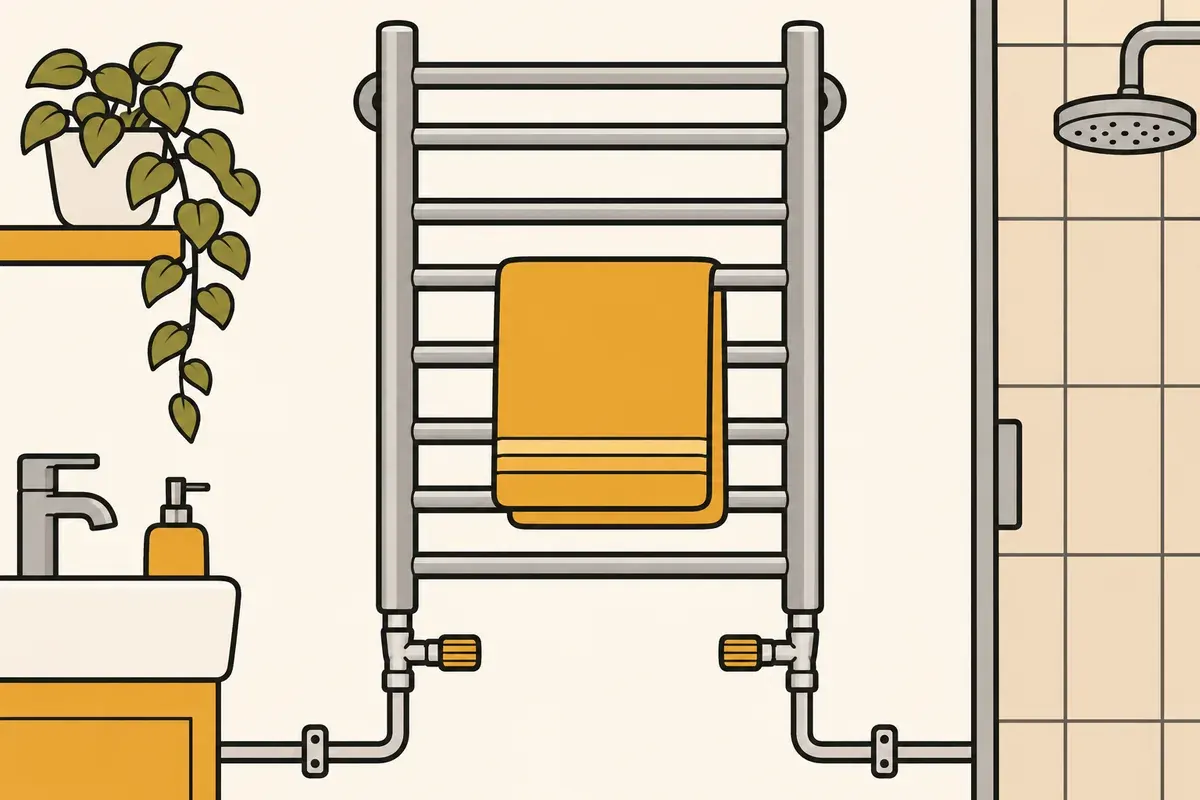
How to bleed a towel radiator: confirm trapped air, open the vent safely, close it at the first steady water and check system pressure afterwards.
If a heating-fed towel rail is warm at the bottom and cold across the top, air may be trapped. With the heating off and the rail cool, open the small bleed valve at the top about a quarter to half a turn, wait for the hiss to finish and close it as soon as water appears.
Check the type of rail
- Central heating only: can be bled as described.
- Dual fuel: switch off the electric element at its supply as well as the heating, and follow the maker's guide about which valves stay open.
- Electric only: a sealed unit. Do not open it.
Before opening the vent
- Turn the heating off and let the rail cool so hot water cannot scald you.
- Note the boiler pressure gauge if your system has one.
- Find the correct bleed key or use a screwdriver if the vent has a slot.
- Hold a cloth and a small container under the vent. Dirty water stains grout, paint and towels.
Bleed it
Turn the vent anticlockwise slowly. Do not unscrew it fully; the pin can come out and water will follow. Hissing means air is leaving. When a steady trickle replaces it, turn clockwise until snug. Which? advises opening no more than half a turn.
Nothing at all, neither air nor water, suggests a painted or blocked vent, closed radiator valves or too little pressure in the system. Do not dig into the opening while the system is under pressure.
Check the pressure
On a sealed system, venting can lower the reading. Which? gives 1 to 2 bar as the usual range, but your boiler manual states the correct figure for yours. Top up only by the method in the manual. If you have not used a filling loop before, or the pressure keeps falling, get a competent heating engineer, and a Gas Safe registered engineer for anything on a gas boiler.
Open-vented systems fed from a loft tank have no gauge. Check that the tank is filling if radiators repeatedly collect air.
Run the heating again
Warm the system and feel along the rail with care. Wipe the vent and check it stays dry. Replace any decorative cap.
If it is still cold
| Pattern | What it may mean |
|---|---|
| Cold all over | A closed valve, or a system or circulation fault |
| Cold at the bottom or centre | Sludge or a restriction rather than air |
| Warm pipe one side only | Valve closed or flow needs balancing |
| Upper bars never fully warm on a low-flow day | Check the lockshield setting and heating demand |
| Air returns within weeks | Leak, pressure loss, pump or venting fault |
Open both radiator valves before concluding anything. A towel draped thickly over every bar also hides heat and can make a working rail seem cool.
Towel rails and awkward vents
Many chrome rails have vents at the back, where a standard key is hard to turn. A slim key or a screwdriver may fit. Support the rail lightly and do not twist it on its brackets. Work in good light so you can see water arrive.
Repeated bleeding is a symptom
One-off air after draining or refilling is normal. Regular air is not, and adding water frequently brings fresh oxygen that encourages corrosion. Record how often it happens and the pressure before and after.
If a vent leaks, is rounded off or will not seal, leave the system off and ask for help through the contact form. A fault that points to the appliance belongs under boiler repair, which is handled by Gas Safe registered engineers only. For a new rail, see towel radiator fitting.
Questions people ask
Where is the bleed valve on a towel rail?
Usually near the top of one upright, sometimes facing the wall or hidden under a cap that matches the finish.
Should I bleed an electric towel rail?
A sealed electric-only rail should not be opened. Follow its manual, because it is filled to a set level by the maker or installer.