
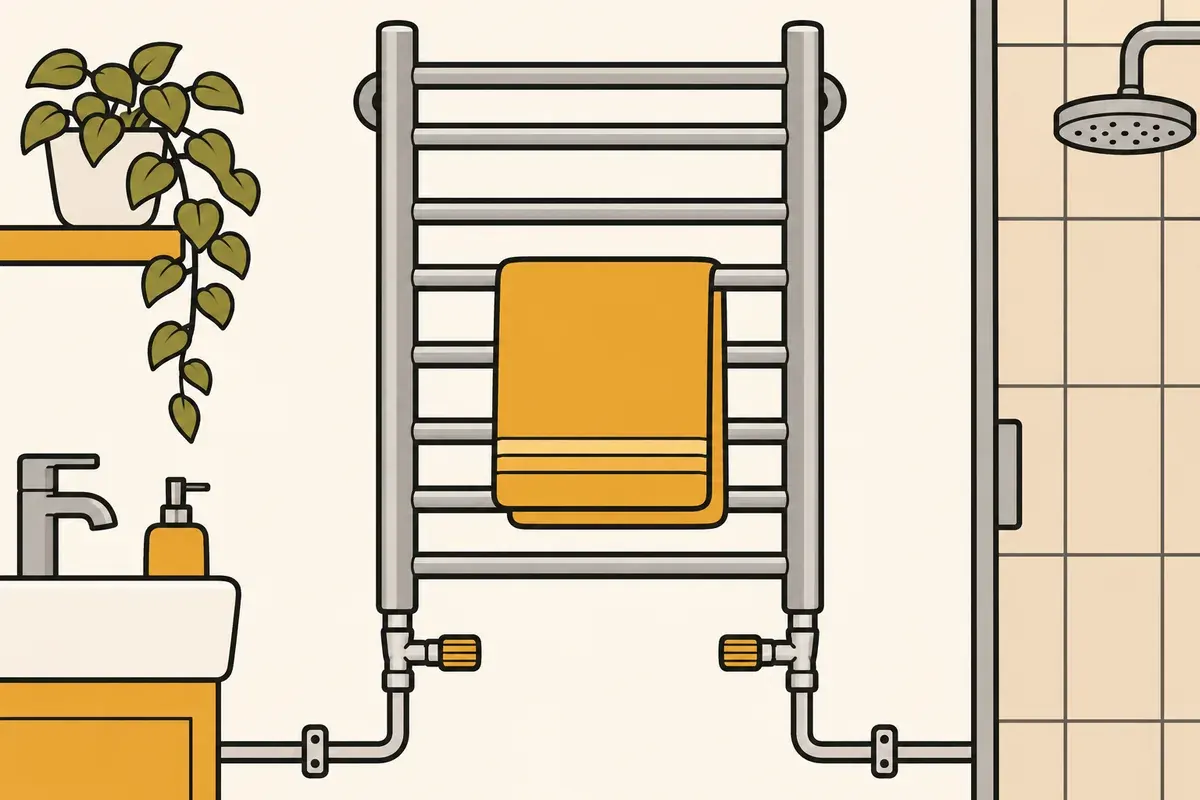
Radiator valve types explained: manual, thermostatic and lockshield controls, angled, straight and corner bodies, and what to measure before buying.
A radiator normally has two valves. One is for control, either a manual wheel or a thermostatic head. The other, the lockshield, is hidden under a cap and sets how much water passes. Separately, the valve body comes angled, straight or corner shaped to suit the pipes.
By function
| Type | What it does | How to recognise it |
|---|---|---|
| Manual wheelhead | You open or close it by hand | Plain knob, no temperature numbers |
| Thermostatic (TRV) | Adjusts flow in response to air temperature near it | Taller head marked with numbers or symbols |
| Lockshield | Sets flow for balancing | Small cap, spindle needs a spanner |
| Smart or programmable head | TRV controlled by timer or app | Battery powered head |
| Dual-fuel tee arrangement | Lets an electric element share a towel rail | Extra tee piece with element in one end |
A TRV controls the room it is in; it is not an on/off switch. Setting it to maximum does not heat the room faster. If a room has the main wall thermostat, ask your heating engineer whether its radiator should have a thermostatic head, and follow your heating system's design.
By body shape
- Angled: turns water through 90 degrees. Common where pipes rise from the floor into the radiator side.
- Straight: runs in line. Suits pipes coming from the wall towards the radiator.
- Corner: turns in two planes so the head or cap sits neatly against the wall.
- H-block: a single unit for radiators with both connections close together underneath.
Stand facing the radiator and photograph both ends from the front and side. The direction of the pipe tail tells you more than a catalogue name.
Sizes to record
- Pipe diameter, commonly 15 mm, with smaller microbore or older imperial sizes in some homes.
- Radiator connection thread, often 1/2 inch BSP.
- Distance from the radiator tapping to the pipe centre.
- Pipe centres across the radiator.
- Space for a TRV head, away from curtains and boxing.
A new valve body rarely has exactly the same length as the old one. A few millimetres can mean altering the pipe.
Direction and orientation
Some TRVs work with flow in either direction; others must go on the inlet and can hammer if reversed. Many heads should sit horizontally, or as the maker shows, so rising pipe heat does not mislead the sensor. A remote sensor is made for enclosed positions.
Stuck or weeping valves
A TRV that will not warm after summer may have a stuck pin under the head. Remove the head only if the instructions show how, and see whether the pin springs up. Do not grip it with pliers or undo the gland or valve body on a filled system.
Drips from a union or gland need attention soon. Put a tray beneath, avoid forcing the nut and turn the heating off if the leak grows.
Changing valves
Replacing a body means draining at least part of the heating system, remaking joints, refilling, adding inhibitor where needed and bleeding. Bodies can sometimes be swapped using special equipment, which depends on the system. Replacing only a compatible TRV head leaves the water side untouched.
For the radiator itself, removal for decorating uses the existing valves without changing them.
Rented homes and flats
Communal heating may specify valve types or restrict draining. Ask the managing agent before altering anything, and tenants should ask the landlord.
Ask for the right job
Email photos of both valves, the pipes entering floor or wall, and the filling point if you know it. State whether you want a head, one valve or a full set changed in the contact form. Faults on a gas boiler are boiler repair work for a Gas Safe registered engineer only.
Questions people ask
Which valve is the lockshield?
The one with a plain cap that needs a tool or spanner to turn. It is set during balancing and not used day to day.
Can any thermostatic head fit my existing valve?
No. Head connections differ between makes. Check the thread or clip type against the valve body.