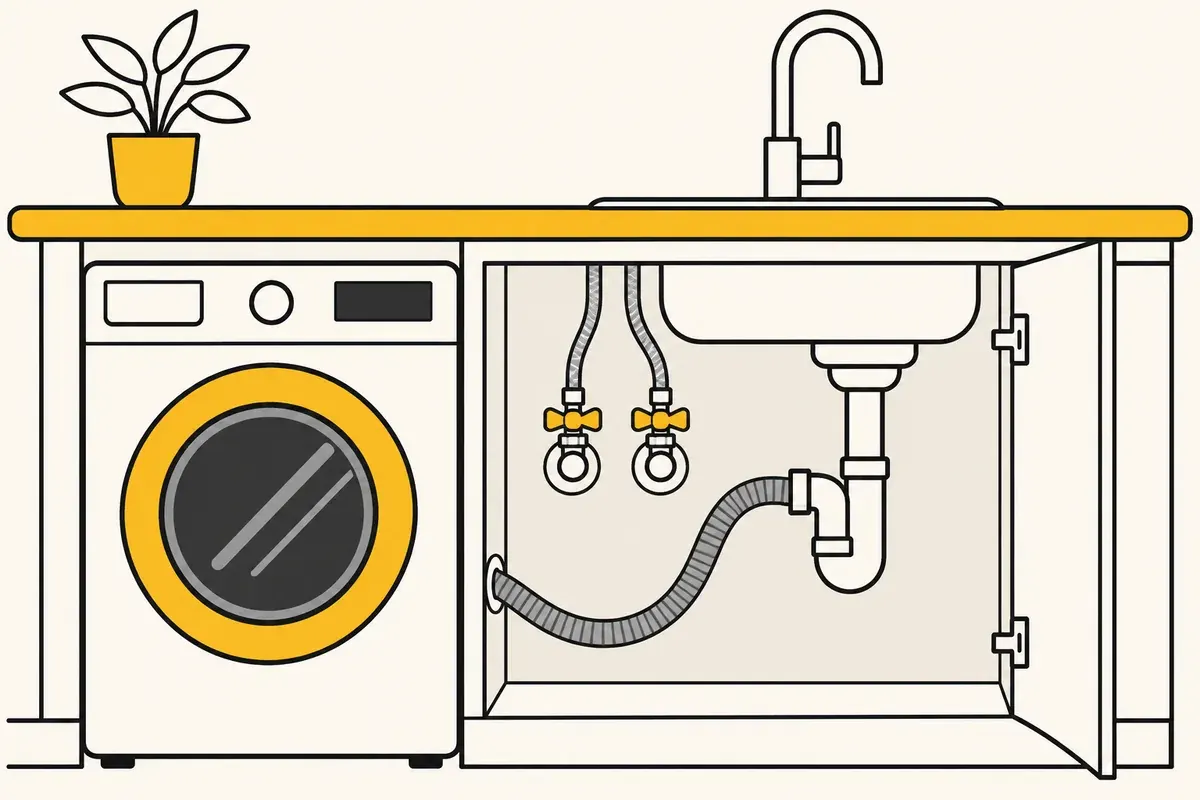
Capping off washing machine pipes: isolate and drain the feeds, cap them properly, remove dead lengths where possible and seal the waste against smells.
After removing a washing machine, shut off its feed, release the pressure, fit a cap made for the valve outlet or pipe end, and blank the waste. If no machine is coming back, taking the unused branch back to the main pipe is better than leaving a long capped stub.
Isolate and empty
Close the small valve behind or beside the machine. Switch off and unplug the appliance, then unscrew the fill hose over a shallow tray, as water will be held inside. If the valve will not close fully, shut the inside stop valve and open a low cold tap until the flow stops. A hot feed, found on some older installations, needs the same treatment on the hot side.
Choose how to close the supply
| Situation | Suitable closure |
|---|---|
| New machine arriving soon, sound valve | Close valve and fit a screw cap with its washer |
| Old or weeping valve staying | Replace the valve, then cap |
| Machine gone for good | Cut back to the branch and remove the tee, or cap close to it |
| Pipe to be boxed in or tiled over | Remove it, or use a joint type allowed in that position |
A hose thread cap seals on a flat washer; check that the washer is present. Compression and push-fit stop ends suit bare pipe when the pipe is round, clean and cut square. Follow the fitting maker's insertion depth and tightening guidance. For compression joints, see making a compression joint.
A long unused stub holds still water that can affect quality, so keep any length that remains short. A water fitting with a joint must not be concealed inside a wall, solid floor or inaccessible boxing. The wider requirements also ask for fittings to be watertight and supported, so clip any stub that is left.
Close the waste
A machine hose may join a standpipe, a spigot on a sink trap or a wall spigot.
- Sink trap spigot: remove the hose and fit the blanking cap made for that trap. Many traps are supplied with one.
- Standpipe: cap it with a push-on or solvent-weld stop end sized to the pipe, or remove the standpipe and trap and blank the branch.
- Spigot with a non-return device: a cap is still sensible if it will be unused.
A trap left in place with no water passing through it can dry out and let drain air into the room, which is why a sealed cap or removal matters.
Test
Open the stop valve slowly and look at every cap with a dry tissue. Run the sink and let a full bowl drain to prove the blanked spigot holds. Look again after a few hours and the next day. Mark the position of any capped pipe on a photograph and keep it with the house papers.
Appliance and electrics
Draining the pump, moving a heavy machine and disposing of it are separate from the pipework. Leave transit bolts fitted if the machine is travelling. A socket that will no longer be used does not need plumbing attention, but any change to it belongs to an electrician.
If the valve is seized, the pipe is lead or old imperial size, or the end disappears into a wall, describe the job on the contact form and email photographs.
Questions people ask
Is closing the valve enough?
For a short gap before a new machine it may be, provided the valve holds and the hose outlet is capped. For permanent removal, cap or remove the branch.
Can I block the waste with tape?
No. Use a cap or blank made for that fitting so that dirty water and sewer air cannot escape.